
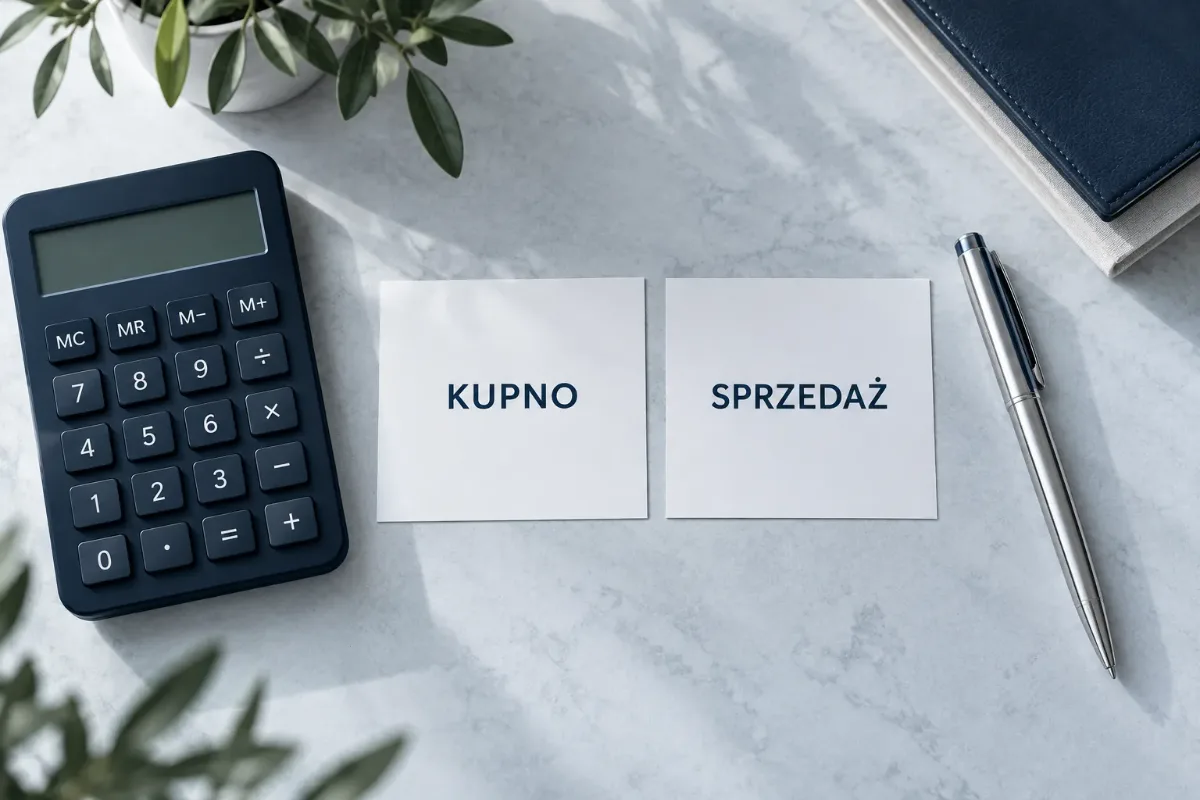
When you look at the rate board in an exchange office, you see two numbers next to each currency. Why does the exchange office buy euros for less than it sells them, and how does this difference affect how much money you end up with? We explain what the currency spread is and how to use it to your advantage.
Buying rate and selling rate
The buying rate is the price at which the exchange office buys currency from you. It applies when you bring in euros and want to receive zloty. The selling rate is the price at which the exchange office sells currency to you, for example when you buy dollars before a trip. The selling rate is always higher than the buying rate.
Note the buying rate and the selling rate of the same currency at the exchange office.
Subtract the buying rate from the selling rate. The result is the spread in grosze.
Divide the difference by the buying rate and multiply by 100.
The lower the spread, the less you lose when exchanging back and forth.
What is the spread
The spread is the difference between the selling rate and the buying rate. The easiest way to compare it is as a percentage: you divide the difference by the buying rate. For example, if an exchange office buys euros at 4.26 PLN and sells them at 4.37 PLN, the spread is 11 grosz, or about 2.6 percent. The lower the spread, the less you lose when you buy currency and then sell it back.
What affects the size of the spread
- how popular the currency is: the euro, the dollar or the pound usually have a lower spread than exotic currencies,
- market volatility: when exchange rates swing sharply, exchange offices widen the spread to limit their risk,
- transaction size: for larger amounts the rate is often negotiated and the spread gets smaller,
- the exchange office's location: offices in tourist areas often have higher margins.
| Factor | How it affects the spread |
|---|---|
| Currency popularity | The euro, the dollar and the pound usually have a lower spread than exotic currencies |
| Market volatility | When rates swing sharply, exchange offices widen the spread |
| Transaction size | For larger amounts the rate can be negotiated and the spread shrinks |
| Location of the exchange office | Tourist spots, airports and hotels often have higher margins |
How to exchange currency more cheaply
First, compare both rates, not just the one written in the biggest font. Second, for amounts from 4 000 PLN ask for an individual rate. At White Money, this kind of wholesale currency exchange lets you noticeably reduce the cost of the transaction. Third, do not exchange money in a hurry at the airport or in a hotel, where the spread can be several times higher than at an exchange office in the city centre.
Rates at White Money
Current buying and selling rates for nearly 20 currencies can be found in the table on our home page, shown separately for retail and wholesale exchange. For the most popular currencies we have also prepared pages with the rate for Kraków: EUR/PLN, USD/PLN, GBP/PLN and CHF/PLN.
Exchanging 4,000 PLN or more? Ask for an individual rate through wholesale exchange, because the spread usually shrinks for larger amounts.
Summary
The spread is the simplest indicator of what an exchange costs. Once you know it, you can easily judge which exchange office in Kraków offers genuinely good terms. If you want to find out what else to look out for, read our guide how to choose a currency exchange office in Kraków.