Which ski trip currency you need depends on where you spend your winter holiday. From Krakow it is a short drive to Slovakia and not much further to Austria, Italy or Switzerland, and the Czech mountains are a popular choice for many families too. Each of these countries has its own payment habits: in three of them you pay in euros, while in the other two you will need a different currency.
In this guide we explain which currency to take where, what you will spend money on at the resort, when cash comes in handy and how to plan your budget without stress. We do not quote prices, because they change from season to season and depend on the resort.
Ski trip currency: a country overview
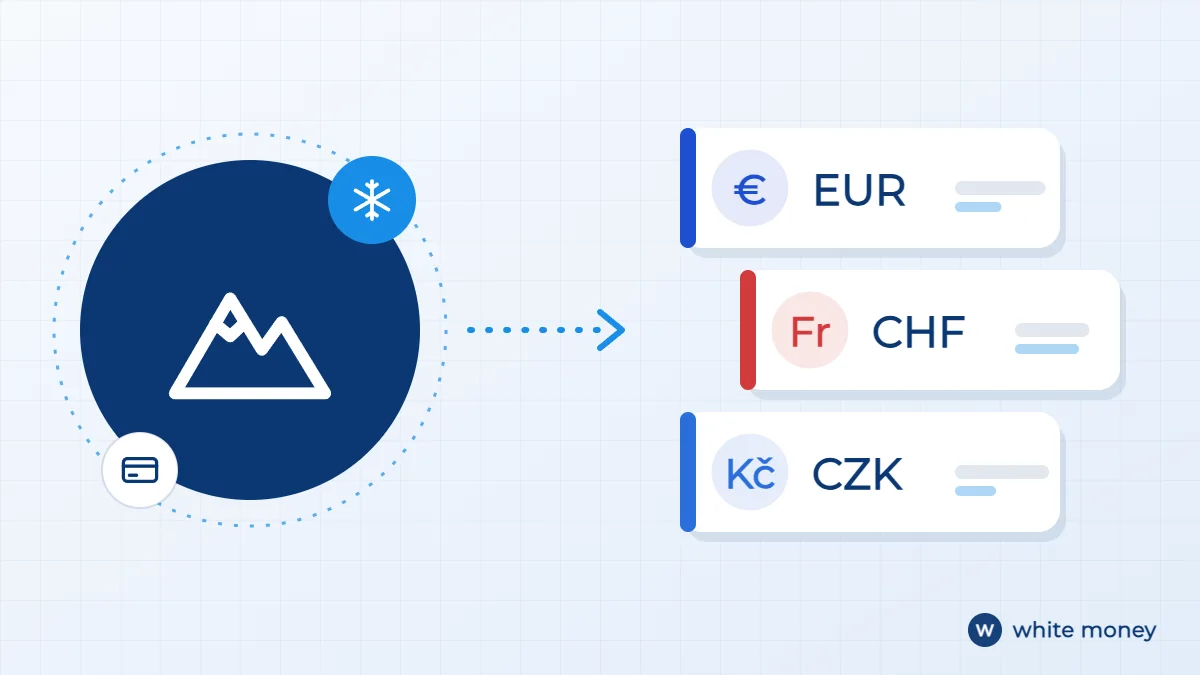
First, the basics. Slovakia, Austria and Italy are in the eurozone, so one currency is enough even if you visit several of these countries on one trip. Switzerland is not a member of the European Union and has its own currency, the Swiss franc. Czechia is in the EU, but you pay there in Czech korunas.
| Country | Currency | Code | What to keep in mind |
|---|---|---|---|
| Slovakia | euro | EUR | Euro since 2009, close to Krakow |
| Austria | euro | EUR | Cards widely accepted, cash useful in small mountain huts |
| Italy | euro | EUR | Same currency as Austria if you combine both on one trip |
| Switzerland | Swiss franc | CHF | Outside the EU, euros only sometimes accepted, change usually in francs |
| Czechia | Czech koruna | CZK | EU country without the euro, prices shown in korunas |
What you will spend money on at the resort
A ski budget is made up of a few fixed items. It is worth listing them in advance, because it helps you work out how much cash you need and how much you will pay by card.
- Ski passes: you usually buy them at the lift ticket office or online, paying by card. Many resorts also sell them online in advance.
- Equipment rental: shops often take a deposit or ask for a card as security. Ask about the rules beforehand.
- Ski school and instructors: how you pay depends on the school, and at smaller resorts it may be cash.
- Mountain huts and slope bars: at big resorts you can pay by card, but in smaller huts high up in the mountains cash is often the safer option.
- Parking, ski buses, small purchases: a few banknotes and coins come in handy here too.
Cash in the mountains: why it is worth having
More and more payments at resorts go through card terminals, but the mountains have their own rules. Mobile coverage can be weak, the terminal at the hut may not work, and the cash machine in a small village can be a long way from the slopes. Cash gives you peace of mind: you can pay for tea at the hut, tip your instructor or pay for parking without looking for another option.
Split your cash between several places: some in your wallet, some in a zipped jacket pocket and the rest in your luggage at the hotel. It is easy to lose things on the slopes, and ski suit pockets are not always as secure as they seem.
When paying by card abroad, choose the local currency: euros, francs or korunas. If the terminal offers to convert the amount into zloty on the spot, it is usually better to decline, because the rate for this kind of conversion is often less favourable than your bank's rate.
How much cash should you take? There is no single right answer, because it depends on the length of your stay, the number of people and whether you pay for accommodation and ski passes in advance. A sensible approach is to prepare enough for a few days of small expenses plus a reserve for the unexpected. If you have some left over, you can sell the banknotes at an exchange office at the buying rate when you get back, or keep them for your next trip. Remember that exchange offices usually buy banknotes only, so it is best to spend your coins while you are still in the mountains.
Switzerland and Czechia: currencies outside the euro
A trip to Switzerland requires francs. Some places will take euros, but they convert them at their own rate and give change in francs. It is better to have CHF from the start. You can check the current rate on the page about exchanging Swiss francs in Krakow. The franc is a currency whose rate reacts to market sentiment. If you want to understand why, read about what affects exchange rates.
In the Czech mountains you pay in korunas. The rules are similar to those in Prague, which we described in the article a weekend in Prague: which currency. It is worth buying korunas while you are still in Krakow, especially if you are heading to a smaller town.
How to plan your currency budget for a ski trip
Settle on the country and currency: EUR for Slovakia, Austria and Italy, CHF for Switzerland, CZK for Czechia.
Separate the expenses you pay by card, such as the ski pass and accommodation, from those you need cash for.
Consider exchanging in several parts in the weeks before you leave, keeping an eye on the rate chart.
Place an order using the "Order exchange" form and collect your currency at ul. Długa 16.
During the winter school holidays many people travel at the same time. Reserve francs and korunas, as well as larger amounts of euros, in advance. Less popular currencies are best ordered a day or two ahead so you can collect them without waiting. For exchanges from 4,000 PLN the rate is set individually.
Summary
Your ski trip currency depends on where you are going: euros for Slovakia, Austria and Italy, francs for Switzerland, korunas for Czechia. You can pay for the ski pass, accommodation and most meals by card, but a small amount of cash in the local currency will come in handy at mountain huts, at the car park and for small expenses. The White Money exchange office in Krakow is open daily 9:00-21:00: check the rates in the table, reserve your currency online and collect it before you head to the mountains.